Med Spa Booking Automation: Reduce No-Shows, Save Staff Time
Med spa booking automation sounds simple until you look at what your front desk actually handles in a normal week.
A prospective client asks about Botox during lunch. Another has a laser consultation question after hours. A regular client needs to reschedule. Someone else books elsewhere after receiving a faster answer.
For Med/Health Spas, missed confirmations, unanswered questions, and scattered follow-up can quietly create empty appointment slots. Calendars have an inconvenient habit of revealing those gaps at exactly the wrong time. Good automation handles the repeatable parts so your staff has more room for the conversations that actually need a human.
Why Med Spa Calendars Lose Appointments
Med spa appointments are not always impulse decisions. Clients may be ready to book or still comparing treatments, reviews, downtime, and whether they feel comfortable scheduling a consultation. The American Med Spa Association describes a medical spa as a hybrid between an aesthetic medical center and a day spa, which helps explain why trust matters before booking.

A cleaner booking workflow helps med spas confirm consultations and protect the calendar.
Calendar leaks usually show up in a few familiar places:
- A client asks a question but does not get a timely response.
- A consultation is booked but never confirmed.
- A reminder goes out too late, too vaguely, or not at all.
- A cancellation opens a slot, but nobody has time to fill it.
- A follow-up task lives in someone's memory instead of in a visible workflow.
That usually means your team is carrying too many small scheduling tasks manually. "Remember everything and hope for the best" is not much of a workflow, even when your staff is unusually good at it.
What Med Spa Booking Automation Actually Handles
Med spa booking automation uses connected tools to manage appointment-related communication before, during, and after the booking.

Unconfirmed appointments and scattered follow-up can create avoidable gaps in the schedule.
It can handle:
- Consultation request follow-up.
- Appointment confirmation messages.
- Reminder sequences by text or email.
- Missed-call follow-up.
- Reschedule prompts.
- Waitlist or open-slot follow-up.
- Unified inbox tracking for calls, chats, forms, and messages.
- Internal reminders when a staff member needs to step in.
Automation can handle simple tasks and route sensitive questions to a person, reducing dropped details without turning the front desk into air traffic control. Messages should confirm the time, offer a reschedule path, and avoid unnecessary treatment details.
Where Automation Supports the Front Desk Most
Automation can handle confirmations, reminders, missed-call acknowledgments, intake follow-up, and rescheduling. Staff can focus on client questions and exceptions, while a unified inbox shows what happened and what needs attention.
The biggest advantage is not more messages. It is keeping calls, forms, chats, confirmations, and staff handoffs visible so the team can spot exceptions before they become empty slots. Automation handles routine traffic; the front desk controls conversations requiring judgment and personal care.
How Med Spa Appointment Reminders Reduce No-Shows
No-show reduction is not about nagging clients into submission. Nobody wants seven texts asking whether they are *really, truly, absolutely sure* they remember Tuesday. The better approach is to make reminders useful, easy, and respectful.

Useful reminders make confirming or rescheduling easier without making the message feel pushy.
Reminders are not a guarantee, but research supports including them in a broader attendance process. In a randomized primary-care trial, targeted reminder calls reduced no-shows among patients at high risk of missing primary-care appointments. Arrival rates did not differ significantly. Med spas should treat that as directional evidence and measure their own results.
A strong SMS reminder workflow should answer three questions:
1. What appointment or consultation is being confirmed?
2. What does the client need to do next?
3. What happens if the time no longer works?
Timing should match the appointment type. A general consultation may need immediate confirmation and a reminder closer to the visit. An appointment with preparation instructions may need an earlier touchpoint plus a final confirmation. Use the med spa's approved timing, consent process, and client preferences, then adjust based on results.
For Med/Health Spas, privacy and discretion also matter. The U.S. Department of Health and Human Services recognizes appointment reminders as part of treatment communications. That is one more reason to keep messages useful and discreet without exposing sensitive details.
That usually means:
- Keep reminder language brief.
- Avoid specific treatment details in general texts.
- Give easy confirm and reschedule options.
- Honor communication preference and opt-out requests promptly.
- Escalate sensitive questions to a staff member.
Useful reminders give clients a clear action before the appointment becomes an empty slot.
Med Spa Booking Automation for New Consultation Requests
Med spa prospects often arrive through website forms, chat questions, missed calls, Google Business Profile actions, social clicks, referrals, and returning-client questions.

A structured intake path helps new consultation requests move toward a clear next step.
If those inquiries are not captured and routed cleanly, the business can spend money creating demand and still lose people at the point of contact. Leads do not become more interested while quietly aging in an inbox.
A useful intake path asks about the service of interest, whether the person is new or returning, preferred contact method, and timing. Staff gets a better starting point without asking automation to diagnose or promise.
A Practical Med Spa No-Show Prevention Workflow
Map new consultations, follow-up visits, treatment appointments, memberships, wellness visits, reactivation, and provider-specific bookings.
Then build five clear layers around each appointment type:
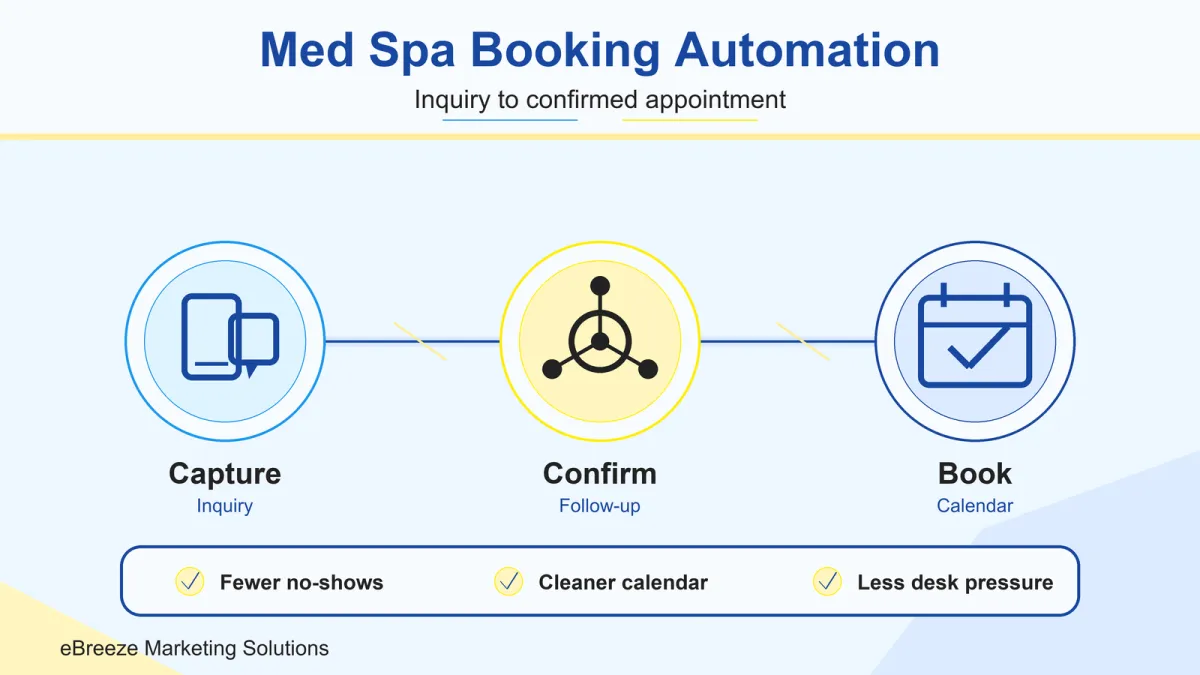
1. Capture and route: Collect the request, preferred contact method, and timing without asking automation to diagnose.
2. Confirm immediately: Acknowledge the request or appointment and explain the next step.
3. Make changes easy: Give the client a simple way to confirm, cancel, reschedule, or ask for help.
4. Recover openings: Route cancellations to an approved waitlist or follow-up process.
5. Measure results: Review confirmation, cancellation, rescheduling, no-show, and recovered-opening rates.
Some med spas use deposits or card-on-file policies for selected appointments. The chosen policy should be explained clearly and handled through the med spa's approved payment process. Automation can communicate the policy, but it should not invent one.
A manager should be able to see where confirmations, reschedules, no-shows, and recovered openings are getting stuck. If the answer is always "ask the one person who remembers everything," the workflow still needs work.
How to Keep Med Spa Automation Personal and Trustworthy
Med spa automation must be useful without becoming careless.
Confirmations can mention the appointment time without listing sensitive treatment details. Reminders can request confirmation without broadcasting private information. Follow-up can invite questions without pretending to give medical advice.
Good messaging should feel useful, recognizable, and easy to manage. Identify the med spa clearly, keep reminders focused on the appointment, let clients update their communication preferences, and stop promotional follow-up when someone asks. The goal is a helpful conversation, not a notification marathon.
Keep the handoff human through clear staff notifications, visible message history, calm wording, and an easy way to ask for help.
Honest, careful use of automation earns more trust than pretending it is human.
FAQ
What is med spa booking automation?
Med spa booking automation uses connected tools to manage confirmations, reminders, missed-call follow-up, rescheduling, consultation requests, and message tracking.
Can automated reminders reduce med spa no-shows?
They can help by making it easier for clients to confirm, cancel, or reschedule before the appointment time.
Will consultation reminder texts annoy clients?
They can if they are too frequent, too vague, or too promotional. A better reminder is short, useful, and easy to act on.
Can booking automation help with after-hours med spa inquiries?
Yes. After-hours forms, chats, and missed calls can trigger an acknowledgment, capture basic information, and create a follow-up task.
What happens when a client needs to reschedule?
A good workflow gives the client a clear reschedule option and alerts the team when needed. The open slot can also trigger waitlist or follow-up outreach.
Does med spa booking automation replace front-desk staff?
No. It should support the front desk by handling repetitive tasks. Staff should still handle sensitive questions, exceptions, and personal client care.
How quickly can a med spa start using automated appointment reminders?
Timing depends on the calendar, messaging tools, consent process, and workflow complexity. Start with one appointment type, confirm consent and staff-handoff rules, and test reminder and reschedule paths before expanding. That is less dramatic than a giant "automation" switch, but easier for the front desk to trust.
Where eBreeze Fits
eBreeze Marketing Solutions builds done-for-you systems around the way customers contact small businesses. For Med/Health Spas, that can bring Booking and Appointments, SMS Messaging, Unified Inbox and Messaging, and Conversational AI into one plan. We connect only supported calendars and owner-approved workflows after reviewing the current practice setup.
We map the intake, messaging, calendar, and follow-up process, then address gaps that create extra work or lost appointments. Better technology should reduce the juggling, not hand your staff three more things to juggle.
